Thursday, 10 December 2009

Ethical Fashion Forum - 20th November

MORAL FIBRE VS THE WEST COAST WEAVING ESTABLISHMENT (WESCOTEX)


Local materials and production VS globalised production


Both companies are based in India, they both sell cotton items among others: bed linen , cushion and cotton fabrics.


Moral Fibre offers hand spun and handwoven cotton, dyed with only natural dyes that are harmless to people's health and the environment. They sell fabrics, a feel-well fashion range and a furnishing range.

Some historical facts are interesting to understand the motivation behind Moral Fibre's cause.


In the early 18Th century, India had a very powerful influence in the textiles business, so much that it started to badly affect the British wool and silk imports.

In 1970s, the British, to restore their status, end the concurrence and benefit from the Indian market, instored an import duty on East Indian Fabrics. India lost his place as a supplier to the world of fabrics (...).
America and England became business partners and create the Trading Triangle between the USA, England and Africa. Great fortunes were made for a few, on the backs of the poors.


The textile industry in India did not break down totally and small quantities of textiles were still produced.


Between the 1920s and 1960s, the invention of man made fibres changed everything in the textiles world, cotton was not No 1 anymore. the consummation generation started here and cheap clothes were available to everyone. Behind the label of a cosy fleece lie some uncomfortable truths.

Pesticides and other chemicals to grow cotton have also invaded the textile world, as cotton is prone to insect attacks. The cotton farmers have to handle dangerous chemicals and pesticide which harm their health and damage the land. as well as the pesticides and chemicals issue, genetically modified cotton has appeared on the market It is also a threat for the environment and for the people whose lives depend on the growth and trade of cotton.


In 2007, consumers worldwide spent over US $1 trillion on clothes. Yet the garment industry remains one of the worlds most exploitative sectors, against people and the environment.


Moral Fibre has two aims:
  • to develop environmentally friendly fabrics

  • to make the process of fabric making socio-economically sustainable


Moral Fibre wants ethical clothing; inspired by Mahatma Gandhi and the hand work of many fabric producers in India; Moral fibre provides work and places to live for their workers and hand spun and hand woven fabrics which means it is almost zero carbon foot print.

http://www.moralfibre-fabrics.com/


I chose to compare Moral Fibre to The West coast Weaving Establishment (Wescotex)

As mentioned above, both companies sell similar type of products and are both based in India.

While Moral Fibre principles are all about ethics and sustainability, Wescostex's ones are all about exporting to as many countries as possible and growing bigger!

The company was created almost 100 years ago, in 1916. With its team of more than 2000 employees (nothing about how they are considered, paid or recognised...) it has now obtained the status of Export House recognised by the government of India and have been awarded the Government of India gold medal for excellence in export performance ( fast.. but is it eco-friendly?)

Even though the company claims to use eco-friendly dyeing and azo-free dyestuff, they are proud to promote vibrant hues, weaves and designs.


Even though my opinion can be seen as slightly too subjective, I am not able to see ethics and sustainability as Wescotex values, they might have use some bits of eco-friendly materials but it is clearly not their first aim, their website and company description is all about the prestige, they money and massive production!

I have been charmed by Moral fibre's values for they are very ethical, they see the human being behind the clothes. They care about the planet and the people trying to survive in the material and consummation world we live in. Their aim is undoubtedly to conserve and value the beauty of Indian clothes maker work and help them have a better life out of it.

http://www.wescotex.in/

Friday, 27 November 2009

An artist cannot fail; it is a success to be one.

Textiles Futures Research Group Co-Design

Very hard to understand for me, very fragmented notes but interesting theme.

Jennifer Ballie


"Co- Design is a term that contains participatory design, meta design, social design and other design processes that requires participation"


Different aspects of Co-Design:


  • Design Activism

  • Customise

  • Fashion Systems and Service ( share and play)

  • Fun and functional Fashion Crowd sourcing

  • Crowd sourcing

  • Transformation design( Berber soepboek, assembling pattern)
The reason behind Co-Design:
"Design is only reaching 10% of the population" ( the wealthiest)

Main Message

Human centered design

Hear - Create - Deliver

Customers as co-designers concept

Some interesting co-design work:

Vivienne Westwood, DO IT YOURSELF

http://ethicalstyle.com/2008/10/vivienne-westwood-do-it-yourself/

Hacking Couture


http://hacking-couture.com/


Customers as Co-Designers, a framework for open innovation, Piller F.C. Schaller and D Walcher (2004)

Saturday, 14 November 2009

Textiles and Culture

Lectures of 30Th October and 13Th November and V&A Visit

As human being part of a certain culture, society and upbringing, how important is textile to our life?

It is very interesting to look at textile in the context of human activities; textiles are quite central to our lives.
The most straight forward example is the one of our birth; in probably every culture, the new born baby is wrapped in a piece of cloth. It represents security, warmth, protection.


Textiles and clothes are very fragile as it cannot survive the damage of time as much as wood or bronze can, therefore there is not many dated pieces for our records.
With the pieces that survived, because of the way they were looked after and conserved, whole new debates take place: Mass Production VS Craft

How is Textiles perceived?

We came out with the idea that it depends on the function it has been created for.

In the Middle Ages, embroidery was prolific in England , there was no authorship, no one was owning the respect for making embroidered garments; even though it was made using one's hands and skills, it was made in a more mass production way.

In 19Th century, William Morris, an architect, furniture, textile artist as well as a writer, was a major name in the Art and Craft movement, which reformed the way decorative art and craft were conceived and made. Textile was no longer exclusively associated with mass production but was also associated with craft.

The context influences a lot the perception of textiles.

The time and the place are very important factors in the identification process of textiles.

There are many examples of textiles pieces or objects that that could influence either point of view.
One that I particularly liked is the Arbadil Carpet, a famous Persian carpet made in the mid 16Th century. It was a request from the Shah Tahmasp I for a mosque. The carpet is considered s one of the biggest carpet ever woven (10.51m x 5.34m); the design is extremely meticulous and beautifully done.


The carpet is exposed at the Islamic Art section at the V&A; it is lit every half an hour for ten minutes, so it prevents it from losing his colour.
I think it is a magnificent piece of textile and I admire the exceptionally precise work, the patience and the time put into it.
And even if it might be senseless after arguing about craft and mass production the feeling I had in front of the Arbadil carpet was: do I really care if any of those beautifully made textile pieces are craft or mass production? No, I just would like to enjoy what I have in front of my eyes .


Another interesting discussion about textiles is its function.
I would say that the purpose of textile defines its function.
Consequently, there can be many functions/ aspects to it.

The first and most evident one is to have something to put on ourselves, we need clothes. As mentioned in the introduction, our very first contact with fabric is at our birth. Our clothes more than a protection, can also be a way to express ourselves it has become a huge business sometimes very far from it first function, protection.

The second aspect is textiles as objects.


Here is a short list:

-Tee Pees made out of animal skin
-Parachute or hot air balloon, a piece of cloth that can break the fall.
-The samurai armours, different colours represent the ranks in the hierarchy
-BMW mock-up car made out of coated Lycra, it saves from waste Seat and belts of any car, made out of resistant fabrics
And many more, textiles are everywhere!

The third aspect is Fine Art. So many artists have used textiles in their work.
Here are some of them:


-Louise Bourgeois, knitted bodies, embracing bodies
-Christo Runningfence, a fence 5.5 meters high and 39.4 kilometres long made out of heavy woven white nylon fabric
-Tracey Emins, embroided blankets
-Michael Raedecker line-up, using stitches and thread in his composition.

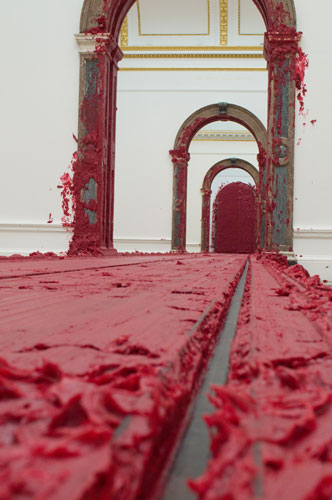
- Anish Kapoor -

I went to Anish Kapoor exhibition at the RCA a couple of weeks ago...
I had been seeing the big posters on the wall on any underground platforms, they always caught my attention because of the blood and guts that was on it...
I personnaly think it was a great picture to use because we, human beings, are always more interested in something when it is morbid.
so I wasn't really sure what to expect but i went to see it anyway, I had so much fun!! I loved the non-object room with all the mirrors and I really found facinating to found out that the blood and guts that I interpretated were in fact wax...
I think that the exhibition is very well curated and I would recomend it to any one, even families as it is very straight forward and interactive.

Saturday, 7 November 2009

On collecting - art and artifacts

This lecture was very interesting, I took some notes of what I understood and what I would like to explore more.
All in a higgledy-piggledy way...

First , a definition for ARTIFACTS: a representation of human culture - objects that represent a human civilization and culture.

About collecting and creating a collection, I like to associate it to the expressions personal environment, memories, one's own vision of (an aspect of) the world , a vision of his relationship with the world, mysterious love of things, identify something or someone, symbolic ( those terms are taken from the introduction of Art and Artifacts, The Museum as Medium, Putum J. 2001)


The hierarchy of art - how museums and collections give evidences of the hierarchy that occurs in art.
We talked about ethnography, the study of a human culture by another human culture, it is not neutral and will never be.

We looked at Africa.
Africa has been conceived by European as one entity.
When Victorian explorers, scientist and missionaries first arrived in Africa, Africa seemed to get "darker" they saw Africa through an imperialist ideology. an ideology of difference, the creation of others. the illusion of race. Race is a human creation, we are all Homo sapiens.

A practical example of the hierarchy of art ( which can be linked to the surrealist hierarchy of races) is the controversy around the Statue of the Queen Mother from the Kingdom of Benin, now part of Nigeria. The Queen Mother was really important to the Benin population as she was the mother of Oba the ruler of Benin; Oba was poly morph and only his mother could be very close to him and talk to him about his power.
There are several statues that were made of the Queen Mother and Oba himself, the statues were made in a very ingenious way using the lost-wax casting method ( a mold is created of the exact negative of the original objects, the mold is at least made of two pieces that can, then, be put together, bronze is then poured in the empty space in between the molds and create the statue or object wanted.) The art historians do not believe that the Benin population made the statues as it was made in a very clever way.

The debate is also about how museums present the artifacts, and the way they label them as the definition of Africa, but they are in reality only a tiny part of the huge puzzle Africa is. it is an ethnographic metonym. It is absurd to pretend that you can describe the immensity of a whole culture with a few hundreds objects.


Reading and people:
George Kubler The Shape of Time Remarks on the History of Things
Josephine Baker Negrophilia: Avant-Garde Paris and Black Culture in the 1920s
Robert Goldwater
Walter Benjamin
Patrick Balendger Race, Writings and Differences chapter 8 and 9, edited by Henry Lewis Gates Jr.
James Clifford The predicament of culture

Sir John Soane's Museum


Sir John Soane was a renowned architect ( his most recognised work is the Bank of England) and an art lover and collector.
He hoped that his two sons would follow his path and become architects too, but they showed little interest in art and architecture so Sir John Soane decided to make his knowledge and art collection (that he acquired with time) beneficial to others. Soane was a professor of architecture at the Royal Academy of Arts Architecture Schools. He first opened his collection to his pupils and then to the general public, his house became a museum and is still very frequented by students and worldwide art lovers.

I think that the Soane family story is a common story; similar stories have been heard:the parents expect a lot from their children and end up disappointed by their life choices. To have learned about this aspect of his life and his motivation to create the house-museum makes me feel sympathy for him, I feel it makes him more accessible , he is no longer Sir John Soane but John the guy next door who after his sons told him they did not want to become architects he open his collection to the public...

His house looks, from the outside, very much like any houses on Inn Fields Rd. This is only when you enter that you can realise that his place was/is far from ordinary.

My first feelings when discovering the first few rooms of his house, I felt like I was in Ali Baba’s Cavern but tidier; there are so many objects from the most common to the rarest; I noticed the rooms were not so filled up with objects but the halls and corridors were.

On my visit I made a list of all the objects that I liked; they could be a starting point for a collection of my own or a future project.
-In the first room on the right, I liked the glassed bookshelves, not one empty space.
-The vestibule with archaeology stones up onto the ceiling.
-The plain stained window.
-W. Hogwarts, The marriage, 1697- 1764 in the room of many paintings.
-“Dieu est mon droit” emblem.
-The windows’ view seems to be an artistic composition in itself.
-All the signs that indicate where we could go; West/ South/ Monk Parlour/ Breakfast Room.
-The basement with the tomb and the urns; the outlook from the floor above.
-The ivory table and chairs from India, late 18th century; I liked the pattern.
-The ground floor map of Sir John Soane’s House made by himself.
-The little lobby on the way up the stairs with a pizzaiolo picture look-alike.
-The gold key with the royal arms of William III.
-Bernard Quaritch’s General catalogue of books Supplement 1875-1877 huge!
-The ceiling in the breakfast room, beautiful pattern!